History of Cell Phones
Are you searching for information on the history of cell phones and want to understand more about one of the greatest inventions by man? Cell phones have totally changed the mode of communication, and the following article will help you learn more about your favorite gadget.
One cannot imagine life without cell phones. A cell phone connects us to our network of family, friends, professional associates and social media, and it quietly becomes part of our physical, emotional and mental life — which is exactly what makes its history so interesting. Mobile phones are also referred to as hand phones, wireless phones, cell phones and cellular telephones. At heart the device is a long-range handset designed for data communication within a predetermined network of cell sites: the handset connects to a cellular network, which operates within base stations or cell sites, all interconnected through the public switched telephone network (PSTN). Today it supports text messaging, email, gaming, cameras, video, Bluetooth, radio, MP3 and even GPS.
The Early Groundwork
The story begins not with the telephone but with wireless conduction. In 1832 Samuel Morse conceived the electromagnetic telegraph, and he later demonstrated that a wire's messages could be sent through cables underwater — and even, after a ship snagged his underwater cable, straight through the water itself, seeding the idea of wireless conduction. In 1843 the chemist Michael Faraday began investigating whether space could conduct electricity. A breakthrough came in 1865, when Dr. Mahlon Loomis, a Virginia dentist and scientist, developed a method of communicating through the earth's atmosphere using two kites flown from separate mountains with copper screens and wires; the U.S. Congress awarded him a $50,000 grant. In 1876 Alexander Graham Bell invented the telephone, whose first words were "Mr. Watson, come here, I want to see you."
Toward the Mobile Phone
Several early patents laid the groundwork for a truly mobile phone. In 1908, patent 887,357 was issued for a wireless telephone invented by Nathan B. Stubblefield of Kentucky. In 1921 the Detroit, Michigan police department installed mobile radios of around 2 MHz in their squad cars, immediately running into overcrowded channels and interference. Noting the advance of radio, the U.S. Congress formed the Federal Communications Commission (FCC) in 1934 to monitor and allocate radio frequencies. Through the 1940s radios operating at 30–40 MHz became a common feature of police departments.
In 1945 the world saw "zero generation" (0G) mobile telephones — not cellular, powered by a single strong base station covering one wide area — and the first mobile-radio-telephone service was established in St. Louis with six channels at 150 MHz. Bell's engineers at AT&T designed mobile phone base stations in 1947. By 1956 real car phones were available, though they were bulky and needed a personal operator to switch calls. In 1969 self-dialing arrived as the Improved Mobile Telephone Service (IMTS), and George Sweigert of Ohio was issued a patent for the first modern wireless mobile phone. In 1970 a 75 MHz window in the 800 MHz band was allocated specifically for cell phones, and in 1971 AT&T proposed the first modern mobile phone system.
The First Handheld Phone and the Cellular Era
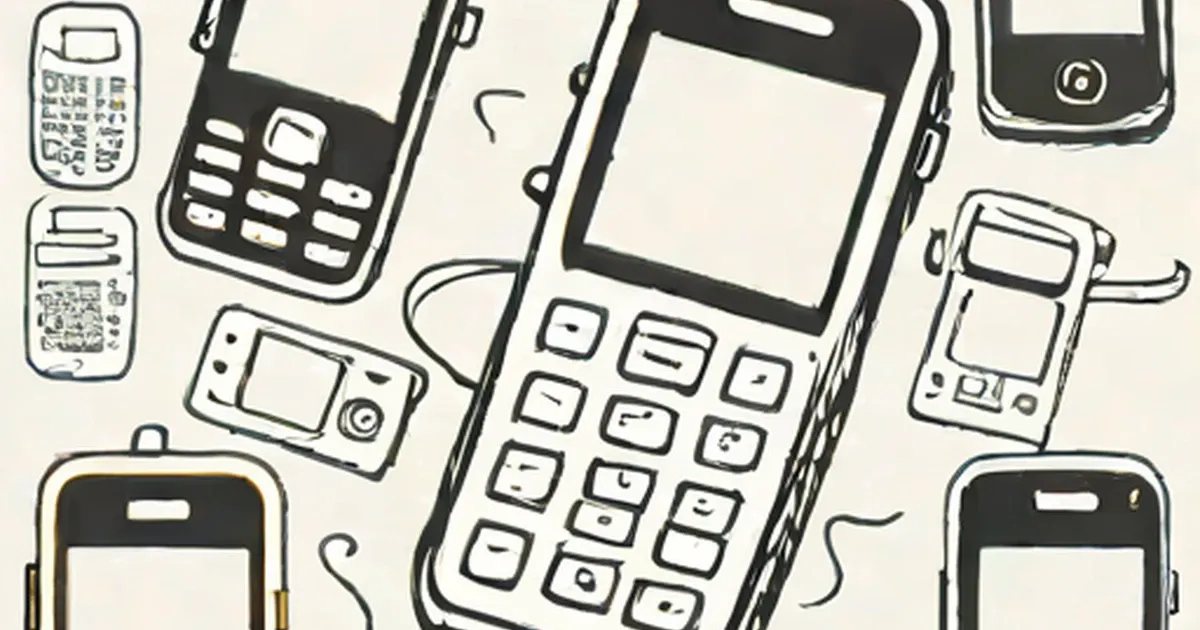
In 1973, Dr. Martin Cooper invented the first practical handheld cell phone at Motorola, exhibiting the Motorola Dyna-Tac to a gasping New York City and becoming the first person to make a call on a portable mobile phone. The first commercial cellular network was launched in Japan in 1979, and automatic cellular networks spread in the 1980s. The first FCC-approved mobile phone was marketed by Motorola in 1983 under the DynaTAC brand — the single-line-display, calls-only handset later popularized as the "Zack Morris phone" on Saved by the Bell, with miserable battery life and an exorbitant price that made it a toy for the rich. In 1984 Bell Labs marketed the first phone that supported multiple, centrally controlled cell sites, allowing conversations to continue as the device moved between networks.
Motorola went on to shrink the phone dramatically: the flip-style MicroTAC covered the keypad with a flap holding the microphone, and the Star Trek–inspired StarTAC was smaller, lighter and the first cell phone with a vibration feature. The 1990s brought "second generation" (2G) systems — GSM, CDMA, iDEN and others — credited to the in-house efforts of Radiolinja in Finland in 1991. The first machine-generated SMS was sent in the UK in 1991, and the first person-to-person text message in Finland in 1993, after which text messaging became a way of life. Finland also saw the first ringtone sales and trial mobile payments in 1998, and Norway saw the first commercial mobile payments in 1999.
The Internet in Your Pocket
In 1999, Nokia introduced the first WAP mobile web browsing on the Nokia 7110, and NTT DoCoMo of Japan launched i-Mode internet access. By 2000 Nokia had dropped the external antenna with the streamlined Nokia 3120, the first phone with T9 predictive text. The camera phone arrived with the Sharp J-SH04, and in 2001 NTT DoCoMo launched the first pre-commercial 3G network, FOMA, on pre-release WCDMA technology — turning phones into pocket-sized computers. From Morse's telegraph to today's video-calling smartphones, cell phones have played a crucial role in shaping world history, and their future — miniaturized, ever more powerful — remains gloriously unpredictable.